Cancer, hepatitis and Thymosin Alpha-1 research
The companion treatment, the comparison group and the outcome all change the claim an added peptide can make.
Liver cancer after curative surgery
The postoperative study of 468 people concerned solitary hepatitis B-related hepatocellular carcinoma, a liver cancer. TA1 use was associated with better recurrence-free and overall survival after curative resection. The virologic response was similar at 24 months.
Matching tries to make treatment groups comparable using recorded characteristics. It leaves an awkward remainder: factors that were never recorded or were measured imperfectly. Here treatment assignment was observational, so the survival association remains open to those explanations.
This survival association deserves a randomised test. The 2019 oncology review places this peptide among additions to chemotherapy and immunotherapy in melanoma, liver cancer and lung cancer, drawing on clinical and preclinical work. It gives a rationale for combinations, with considerable uncertainty about clinical benefit. It cannot establish a treatment for cancer in general.
ETASS and TESTS
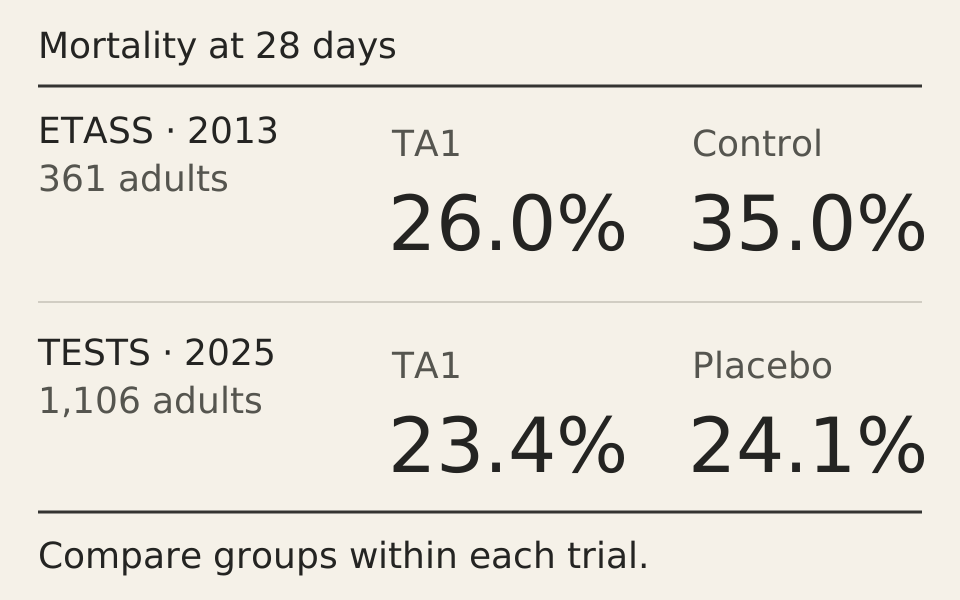
The 2013 ETASS trial included 361 people with severe sepsis. At 28 days, mortality was 26.0% with Thymosin Alpha-1 and 35.0% in controls. Monocyte HLA-DR, a marker involved in showing material to other immune cells, also improved. The mortality finding was marginal rather than conclusive.
The 2025 phase 3 TESTS trial enrolled 1,106 adults across 22 centres and used a double-blind, placebo-controlled design. Mortality at 28 days was 23.4% with TA1 and 24.1% with placebo. It found no statistically significant survival benefit.
Those results are within-trial comparisons; the different trials involved different groups. I trust TESTS more on the sepsis question because its design provides the stronger test. It considerably narrows the case for routinely adding TA1 to the intensive-care treatment studied.
A postoperative trial worth doing
I’d put the postoperative liver-cancer question near the front of the queue for a randomised trial. Recurrence, survival and virologic response could be assessed separately, with the surrounding care specified. The existing matched analysis makes that question interesting without settling it.
Another collection of broadly “immune-supportive” outcomes would be less persuasive to me. The difficult task is to show what the extra treatment contributes when surgery, antiviral care or intensive care has already changed the course of an illness. The COVID-19 record shows how hard that attribution becomes in retrospective data.